Chap3笔记
Chapter 3: Arithmetic for Computer
Computer words are composed of bits, thus one word is a vector of binary numbers. In RISC-V, there are 32bit/word or 64bits/word, in which 32 bits contains 4 bytes.
资源
NoughtQ佬的笔记,讲得非常清晰,感觉比听智云效率高很多. 但是需要注意一个问题,其中的Improved Version除法器原理图中,remainder寄存器在lp老师的slides上面是128bits而非129bits.
Homework: 3.7, 3.20, 3.26, 3.27, 3.32
林芃老师曰:“课上我们默认32bits是1 word,64bits叫做double word.
“教材上有一些用法混乱,之后会指出。”
-
数字表示法:
-
ASCII - text characters (External)
-
Binary Number (Internal)
Natural form of computers
requires formatting routines for I/O
Binary numbers的复杂性导致我们无法从一串二进制码中看出唯一确定的含义.
eg.\(1001_2\)这个数字在Unsigned情况下值为9,在signed情况下值可能为-1或者-7
-
-
Arithmetic Operations:
Addition: adding bit by bit, carries \(\rightarrow\) next digit
Substraction: using 2's complement,比如00000111-00000110,先变成00000111+1_11111010,计算完之后减去.
Overflow:
Operation Operand A Operand B overflow judge (MSB) Result + \(\geq 0\) \(\geq 0\) 01 \(<0\) + \(<0\) \(<0\) 10 \(\geq 0\) - \(\geq 0\) \(<0\) 01 \(<0\) - \(<0\) \(\geq 0\) 10 \(\geq 0\) 上面这张表展示了溢出的判定情况,如当\(A,B>0,result<0\)且最高2位显示为01时,即可认为是overflow了.
ALU Design
-
ALU (Arithmetic Logic Unit):
设计时采用模块化设计(Modular design)的思路.
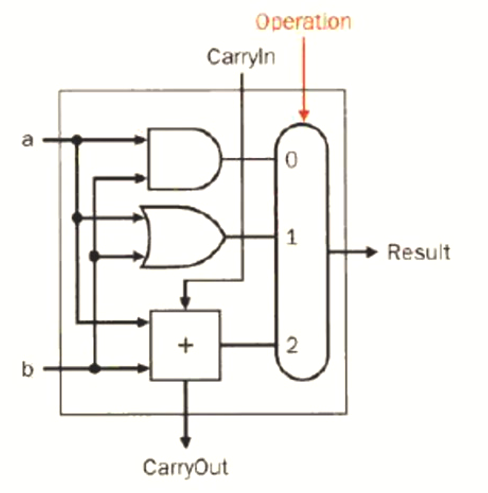
first function: AND, OR
second function: add (half adder / full adder)
1 bit ALU:
于是减法可以用如下的ALU实现:
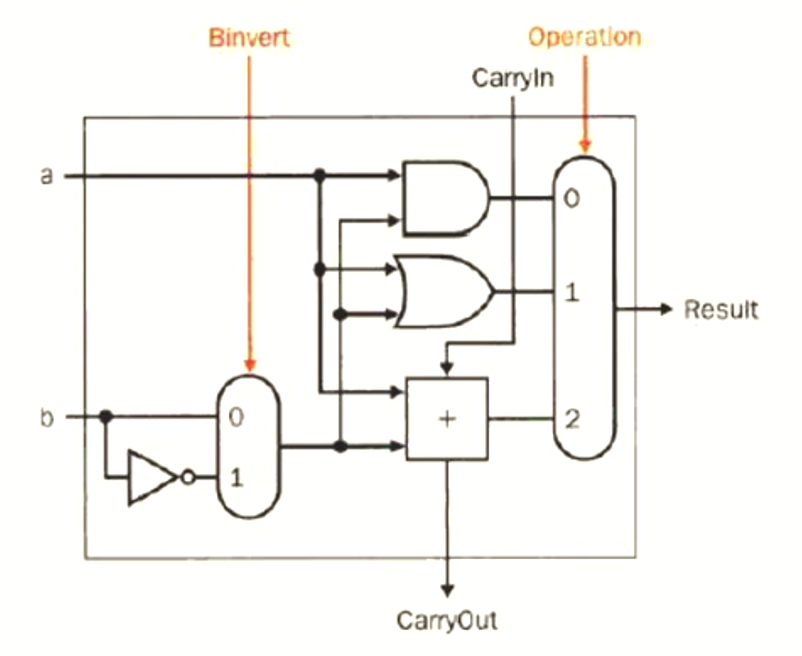
于是我们得到了第4个指令:
sub.目前还缺少比较运算,其指令是:
slt rd,rs,rt。具体含义:slt(set less than),rd是register destination,rs是register source,rt是register target. 功能上,rs < rt时rd = 1,否则rd = 0.另外,
sne是set not equal的意思.Constructing an ALU:有两种方法,Modular design (模块化设计) 和 sharable logic with "select"
Adder
-
ripple carry adder(行波进位加法器): slow
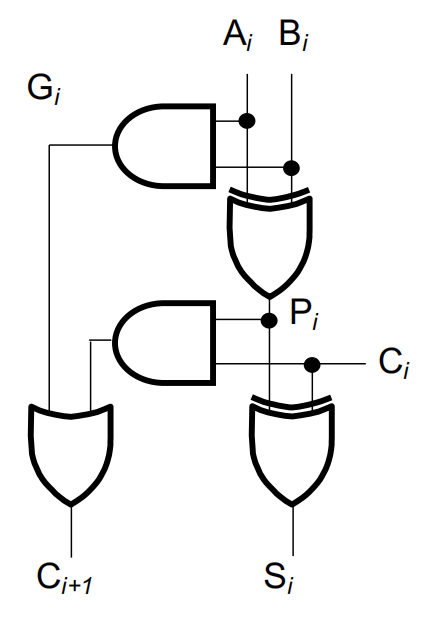
原理推导:
\[\begin{cases} C_{i+1} = A_iB_i + B_iC_i + C_iA_i\\ S_i = A_i \oplus B_i \oplus C_i \end{cases}\]原理图:
-
Group Carry Lookahead Logic
为了加快运算速度,考虑替换掉\(C_{1,2,etc.}\),先定义:
\[\begin{cases} G_i = A_iB_i & (\text{Carry generated})\\ P_i = A_i \oplus B_i & (\text{Carry propagated}) \end{cases}\]原理推导:
\[C_{i+1} = G_i + P_i \cdot C_i \Longrightarrow \begin{cases} C_1 = G_0 + (P_0 \cdot C_0) \\ C_2 = G_1 + (P_1 \cdot G_0) + (P_1 \cdot P_0 \cdot C_0) \\ C_3 = G_2 + (P_2 \cdot G_1) + (P_2 \cdot P_1 \cdot G_0) + (P_2 \cdot P_1 \cdot P_0 \cdot C_0) \\ C_4 = G_3 + (P_3 \cdot G_2) + (P_3 \cdot P_2 \cdot G_1) + (P_3 \cdot P_2 \cdot P_1 \cdot G_0) + (P_3 \cdot P_2 \cdot P_1 \cdot P_0 \cdot C_0) \end{cases}\]所以对于当前位而言,如果\(P_i = 1\),或者前面的位上存在 \(P_j = 1\) 且该生成项\(P_j\)所在位到当前位之间的所有\(G_k = 1(j\leq k\leq i)\),当前位的进位值为 1,否则为 0.
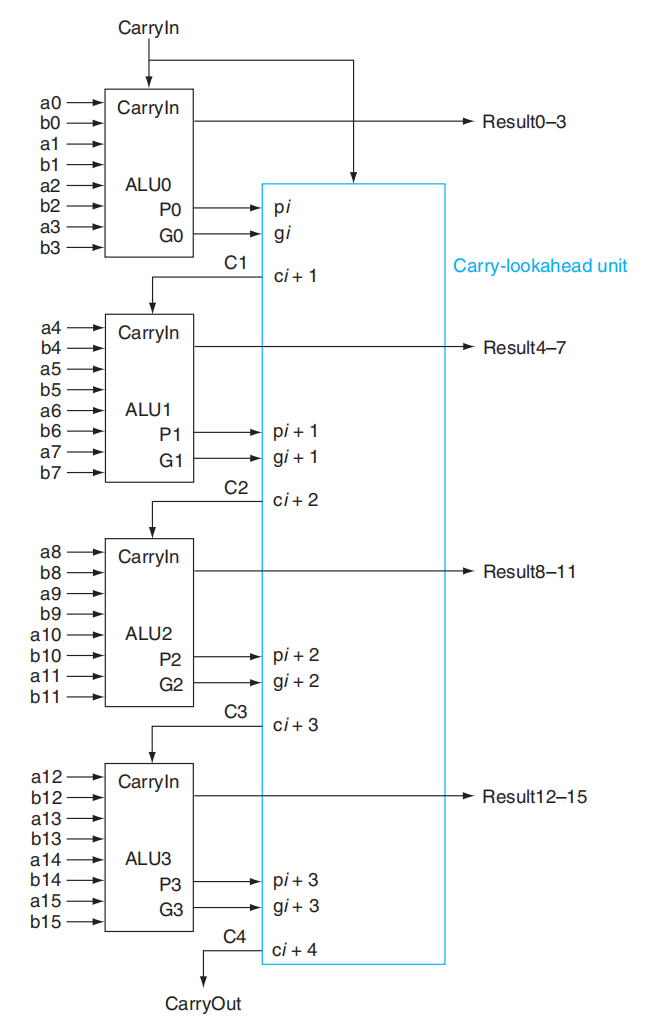
Carry skip adder & Carry select adder 没搞懂,据说不考,先跳过了.
Multiplication
Group Carry Lookhead Logic
完整版看NoughtQ佬的笔记,此处只记录下自己在看V3版本的流程梳理:
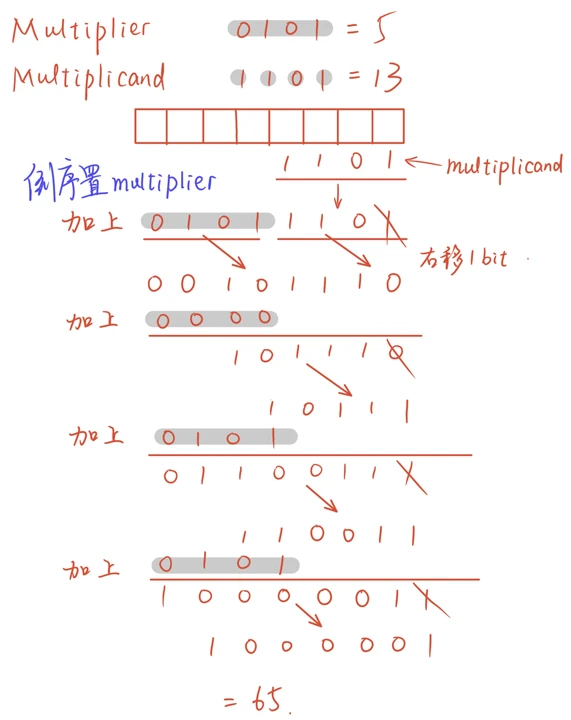
然后是Booth算法来处理signed multiplication:
核心思想:将连续的1串转换为一次减法和一次加法,如:0111 = 1000 - 0001(即8-1=7). 这样连续的1只需要2次操作,而不是多次加法
编码规则:检查乘数的当前位和前一位,分以下4种情况讨论:
| 当前位 | 前一位 | 操作 | 含义 |
|---|---|---|---|
| 0 | 0 | 不做 | 0串的中间 |
| 0 | 1 | +被乘数 | 1串的结束 |
| 1 | 0 | -被乘数 | 1串的开始 |
| 1 | 1 | 不做 | 1串的中间 |
记每组操作为两个阶段:
-
+M / -M / 不加不减;
-
Shift Right
从中我们可以看出,如果是\(64\times 64bits\),则一共有64组操作.
以\(00100010 \times 11011011 = 34 \times (-37)\)为例,其操作流程是:
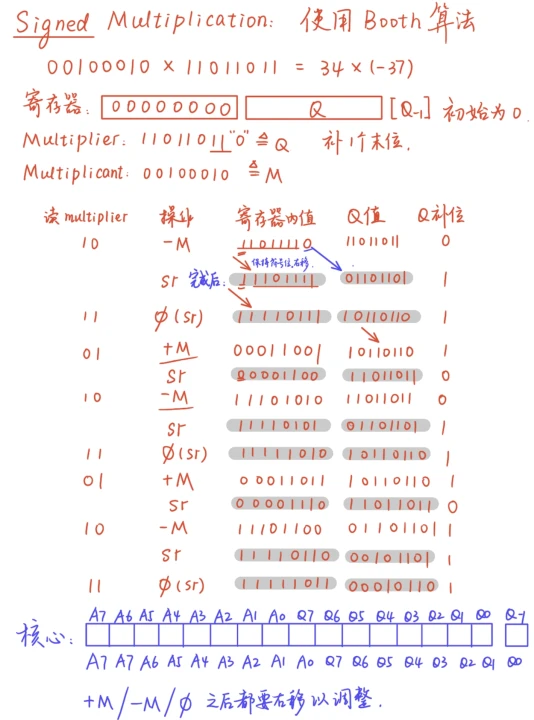
RISC-V中的乘法指令:
mul rd, rs1, rs2     // 64 位乘法,rd保存 128 位乘积的低 64 位
mulh rd, rs1, rs2    // 64 位乘法,rd保存 128 位符号数之间的乘积的高 64 位
mulhu rd, rs1, rs2   // 64 位乘法,rd保存 128 位无符号数之间的乘积的高 64 位
mulhsu rd, rs1, rs2  // 64 位乘法,rd保存 128 位无符号数与符号数的乘积的高 64 位
Division
RISC-V中的除法指令:
div rd, rs1, rs2    // rd保存符号数除法的商
divu rd, rs1, rs2   // rd保存无符号数除法的商
rem rd, rs1, rs2    // rd保存符号数除法的余数
remu rd, rs1, rs2   // rd保存无符号数除法的余数
Floating Point Numbers
Floating-Point Standard
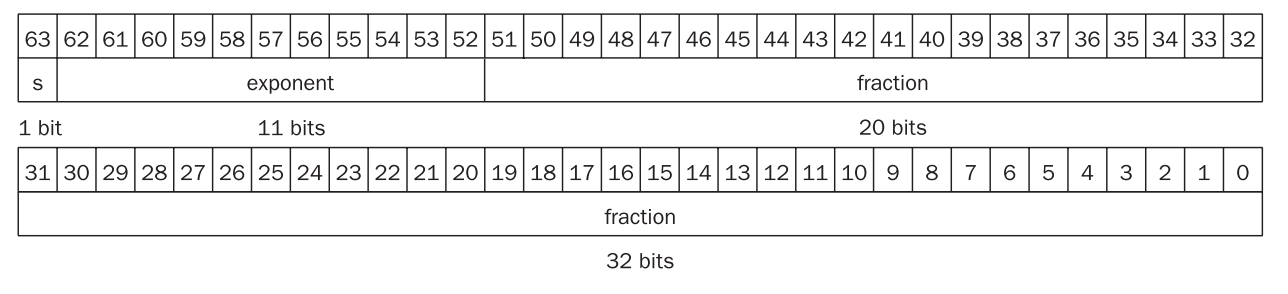
RISC-V浮点数标准来自IEEE 754标准,其将二进制数统一成了规范化数形式:\(1.xxxxx_2 \times 2^{yyyy}\).
浮点数表示法组成:符号\(S\)、指数(exponent)\(E\)、尾数(fraction)\(F\).
浮点数表示法(Sign and Magnitude)中的数字表示形式为:
单精度(float)下,数的范围是

双精度下,数的范围是