Checkpoint 0-Networking Warmup
Networking by Hand
Fetch a Web page
http://cs144.keithw.org/hello 这个网址似乎没有反应,遂作罢.
GET /hello HTTP/1.1+ENTER:告诉服务器URL的path部分HOST: cs144.keithw.org+ENTER:告诉服务器URL的host部分.Connection: close+ENTER:告诉服务器我这边已经完成request,它必须在完成所有reply之后直接关闭.
Send yourself an email
无stanford账号与环境,无法完成.
Listening and Connecting
先运行netcat指令监听9090端口:
新开一个窗口来拨号:
cs144-25fa$ telnet localhost 9090
Trying 127.0.0.1...
Connected to localhost.
Escape character is '^]'.
在监听端口可以看到:
Write network program
目标:
- Fetches a Web page over the Internet
- In this lab, you will simply use the operating system’s pre-existing support for the Transmission Control Protocol. You’ll write a program called “webget” that creates a TCP stream socket, connects to a Web server, and fetches a page—much as you did earlier in this lab. In future labs, you’ll implement the other side of this abstraction, by implementing the Transmission Control Protocol yourself to create a reliable byte-stream out of not-so-reliable datagrams.
从网上找备份代码:
略去一番操作之后编译:
-
作用:显式指定源代码位置和build路径
-
作用:
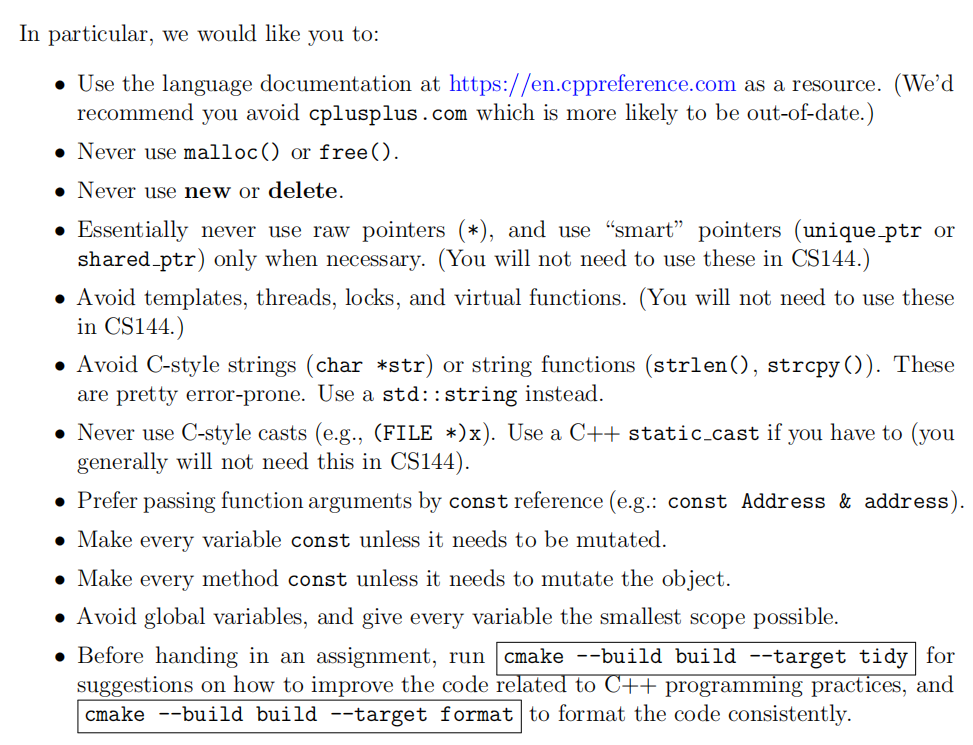
然后是一些C++书写时的约定:
Writing webget
app/webget.cc这段代码本身有一些值得研究的地方:
#include "debug.hh"
#include "socket.hh"

#include <cstdlib>
#include <iostream>
#include <span>
#include <string>

using namespace std;

namespace {
void get_URL( const string& host, const string& path )
{
  debug( "Function called: get_URL( \"{}\", \"{}\" )", host, path );
  debug( "get_URL() function not yet implemented" );
}
} // namespace

int main( int argc, char* argv[] )
{
  try {
    if ( argc <= 0 ) {
      abort(); // For sticklers: don't try to access argv[0] if argc <= 0.
    }

    auto args = span( argv, argc );

    // The program takes two command-line arguments: the hostname and "path" part of the URL.
    // Print the usage message unless there are these two arguments (plus the program name
    // itself, so arg count = 3 in total).
    if ( argc != 3 ) {
      cerr << "Usage: " << args.front() << " HOST PATH\n";
      cerr << "\tExample: " << args.front() << " stanford.edu /class/cs144\n";
      return EXIT_FAILURE;
    }

    // Get the command-line arguments.
    const string host { args[1] };
    const string path { args[2] };

    // Call the student-written function.
    get_URL( host, path );
  } catch ( const exception& e ) {
    cerr << e.what() << "\n";
    return EXIT_FAILURE;
  }

  return EXIT_SUCCESS;
}
get_URL用 namespace { ... } 包起来:表示namespace { ... }是 C++ 的匿名命名空间,放在匿名命名空间里的函数只在文件内部可见,所以get_URL只能被webget.cc里的代码调用,其他文件不能链接/访问它.