[ACL 2026] Temp-R1: A Unified Autonomous Agent for Complex Temporal KGQA via Reverse Curriculum Reinforcement Learning
原先工作的Problem: 现有 TKGQA 方法通常采用由 planner、retriever、generator 等模块组成的固定工作流,不仅依赖昂贵的闭源 LLM API,也限制了模型根据问题难度自主调整推理策略的能力。将 Search-R1 等 RL-based search agent 直接用于 TKGQA 时,还存在以下问题:
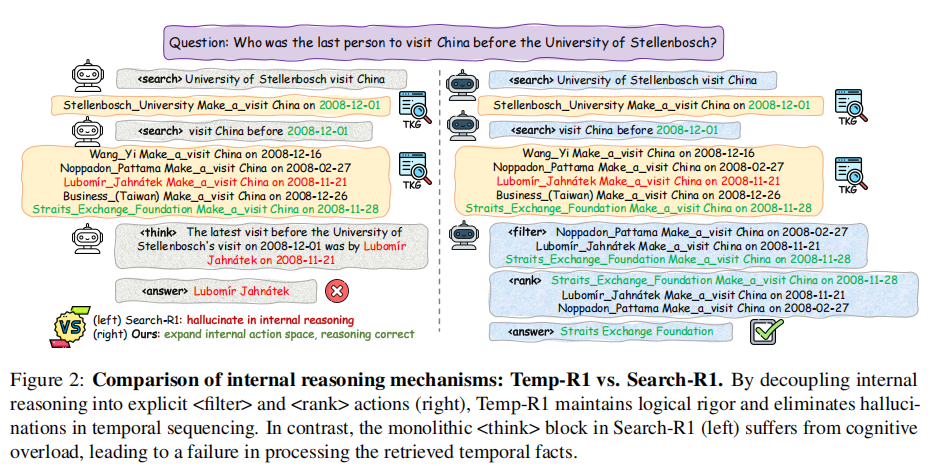
- 内部思考过载(Overloaded Internal Reasoning):单一的
<think>同时承担搜索规划、语义过滤和时间排序,复杂时序问题中容易遗漏约束,甚至对已经检索到的正确事实得出错误结论; - 强化学习中的捷径陷阱(The Shortcut Trap in Reinforcement Learning):MULTITQ 等数据集中简单问题占多数,直接训练会使 agent 过早学会
<search> → <answer>等短路径,在简单样本上取得高 reward 后停止探索复杂的 action combination,形成 path dependency.
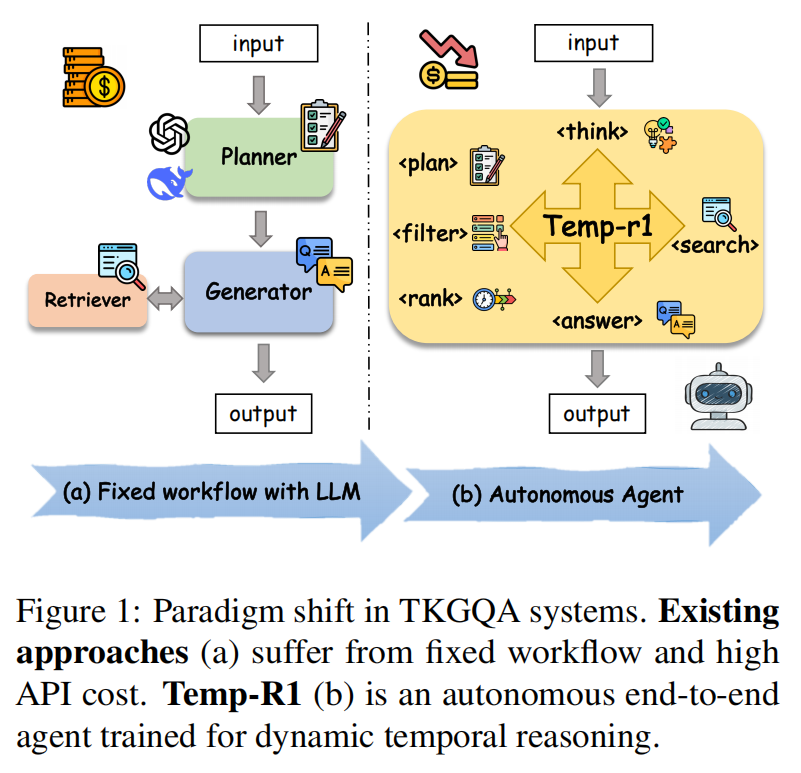
Temp-R1 是一个面向复杂时序知识图谱问答(TKGQA)的端到端 autonomous agent,通过以下四部分学习自主搜索与时序推理:
- Expanded Action Space
- SFT Cold Start
- Group Relative Policy Optimization(GRPO)
- Reverse Curriculum Learning
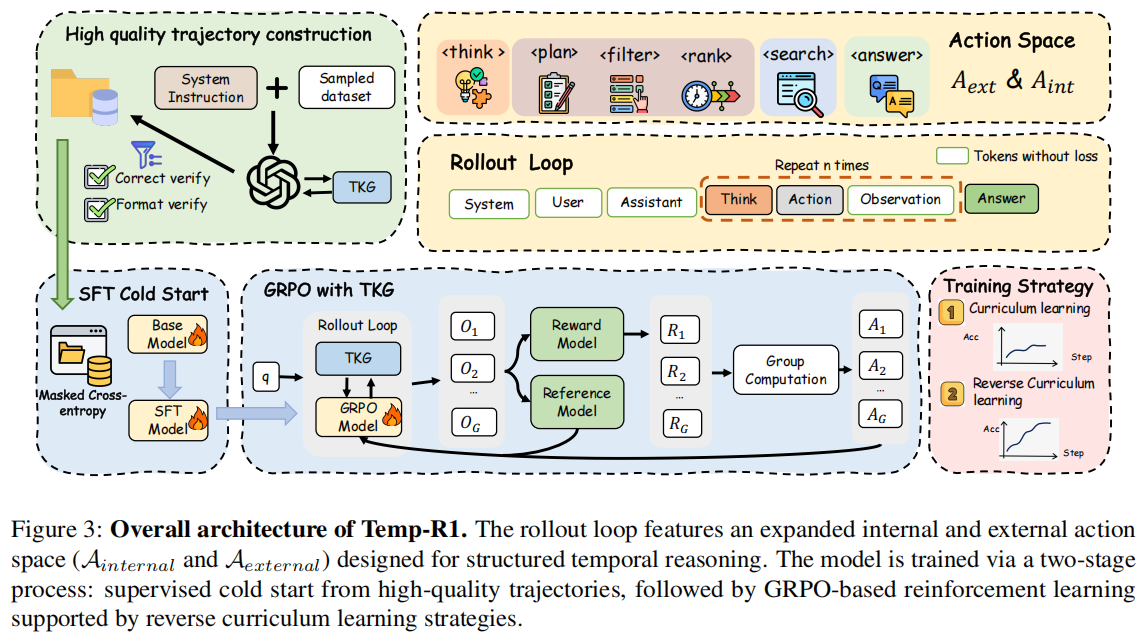
工作流:
-
Rollout Loop(Expanded Action Space):
将 TKGQA 建模为 MDP。除外部检索动作
<search>外,Temp-R1 将<plan>、<filter>和<rank>从通用<think>中显式拆分出来:<plan>分析问题类型、时间约束和子问题,<filter>按语义及时间约束过滤事实,<rank>按时间戳排序,最后由<answer>终止 rollout.\[ \mathcal A=\mathcal A_{\text{internal}}\cup\mathcal A_{\text{external}},\qquad \mathcal A_{\text{internal}}=\{\texttt{<plan>},\texttt{<filter>},\texttt{<rank>}\},\quad \mathcal A_{\text{external}}=\{\texttt{<search>}\}. \] -
SFT Cold Start:
使用 GPT-4o 生成并过滤约 1,000 条高质量轨迹,使 base model 先学会合法的 tag 格式和基本 action sequence。SFT 只对 agent 生成的 token 计算 masked cross-entropy,system prompt、用户问题和检索结果不计算 loss:
\[ \mathcal L_{\text{SFT}}(\theta)=-\frac{1}{T}\sum_{t=1}^{T}m_t\log\pi_\theta(x_t\mid x_{<t}). \] -
GRPO with TKG:
从 SFT policy 出发,对每个问题采样 \(G\) 条 rollout trajectory,并根据组内 reward 计算 relative advantage:
\[ \hat A_i=\frac{r_i-\operatorname{mean}(\{r_k\})}{\operatorname{std}(\{r_k\})+\eta}. \]使用的 reward function 只判断最终答案是否正确:
\[ R=\begin{cases} 1,&a_{\text{pred}}=a_{\text{gold}},\\ 0,&\text{otherwise}. \end{cases} \] -
Reverse Curriculum Learning Strategy:
传统 curriculum learning 从简单问题逐步过渡到困难问题,容易让 agent 先学会短路径。Temp-R1 反过来先使用复杂的 multiple / multi-hop 问题,迫使模型掌握复杂工具组合;超过 warm-up threshold \(T_0\) 后再加入简单问题:
\[ D_t=\begin{cases} D_{\text{multi}},&t\le T_0,\\ D_{\text{multi}}\cup D_{\text{single}},&t>T_0. \end{cases} \]
本文架构优势:将固定 TKGQA workflow 转化为由 RL 学习的动态 action policy;通过 <filter> 和 <rank> 降低单一 <think> 的认知负担,再利用 Reverse Curriculum Learning 避免 agent 在简单问题上形成捷径。最终以 8B 开源模型在复杂时序问题上超过依赖闭源 LLM 的强 baseline,并在推理阶段不再需要外部 LLM API.
Case study:对于问题 Who was the last person to visit China before the University of Stellenbosch?,两种方法都检索到 University of Stellenbosch 的访问日期为 2008-12-01,以及多个候选访问记录。Search-R1 在单一 <think> 中误将 2008-11-21 判断为最近日期;Temp-R1 先通过 <filter> 删除 2008-12-01 之后的记录,再通过 <rank> 排序,最终正确选择 2008-11-28 的 Straits Exchange Foundation。该案例说明错误并非来自检索,而是来自检索后的时间约束处理,显式 action decomposition 可以缓解这一问题.