[arXiv 2026] GTA-RAG: Graph-Trajectory-Augmented Reinforcement Learning for Multi-Turn Retrieval-Augmented Reasoning
- 论文地址:GTA-RAG
- Github仓库:cjcj46262/GTA-RAG
- 更简洁的摘要: 从图中采样文档路径,合成并验证可执行的多跳检索轨迹,通过证据获取奖励与两阶段 GRPO,让 Agent 同时学习正确回答和获取完整支持证据。
原先工作的 Problem:
-
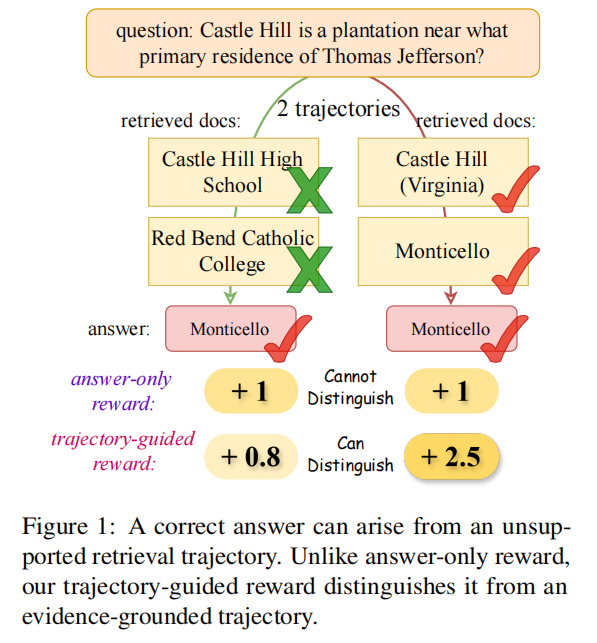
最终答案正确,不代表检索过程正确。 Answer-only reward 无法区分基于支持证据得到的答案与依赖 parametric knowledge 得到的答案。即使检索文档完全无关,只要最终答案正确,模型仍然获得奖励。
-
多轮检索的反馈过于稀疏。 Multi-hop QA 需要识别 bridge entities、连续查询并整合多个文档。仅使用最终 EM,无法直接奖励每次搜索带来的证据获取进展。
-
图路径不一定能转化为有效的检索监督。 文档在图上连通,不保证生成的 query 能通过实际 retriever 找回目标文档;直接使用这些路径训练,可能引入不可执行的轨迹。
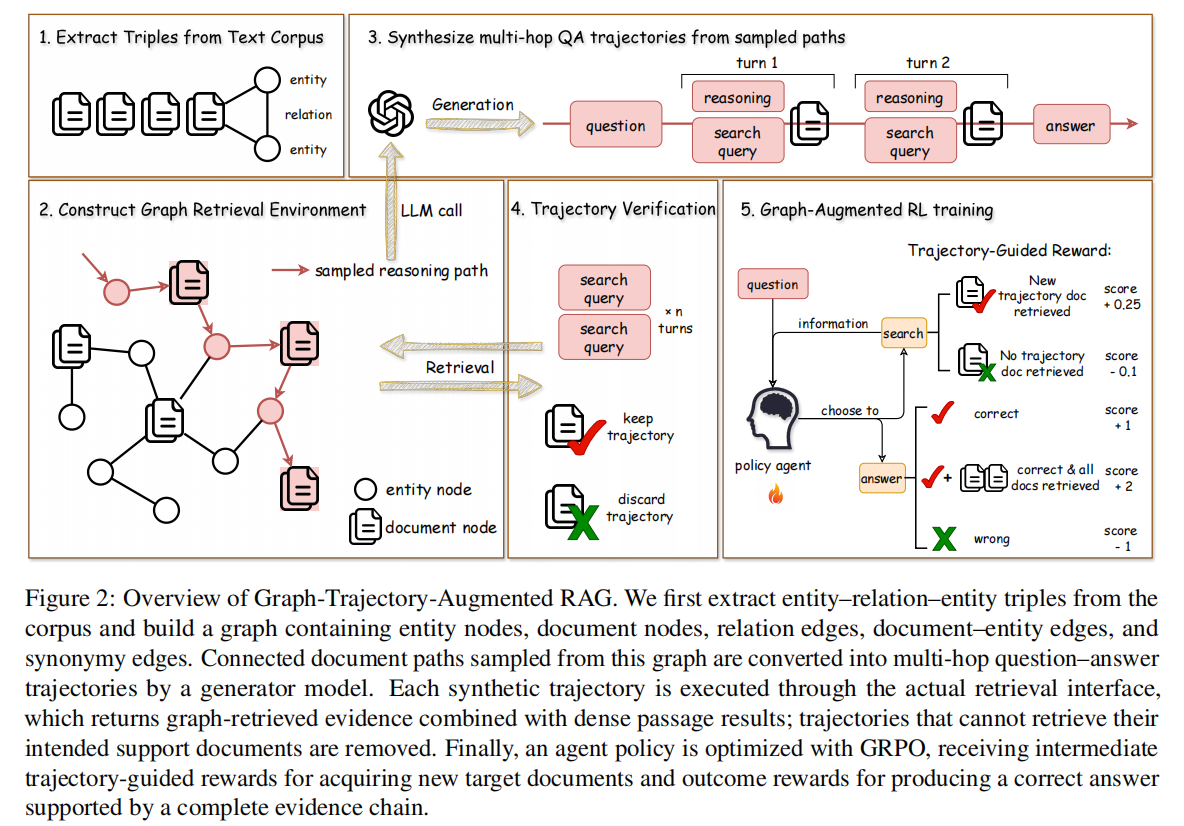
GTA-RAG 是一个利用 graph-derived trajectories 提供证据获取监督的多轮 RAG 强化学习框架,分为以下三部分:
- Graph-Augmented Retrieval: 构建 entity–document graph,将 PPR graph retrieval 与 dense passage retrieval 合并为统一检索接口。
- Trajectory Construction & Validation: 从图中采样连通文档路径,合成多跳 QA 与检索轨迹,并使用实际 retriever 验证轨迹可执行性。
- Trajectory-Guided RL: 先用证据获取奖励学习多轮检索,再用自然 QA 的答案奖励进行任务适配。
图结构同时用于在线证据召回和离线监督构造。Agent 自主生成 search query,检索接口负责图传播与文档召回;目标文档集合用于训练奖励计算,无需在推理时提供。
构建方法论(Methodology)
1. Graph Knowledge Base & Retrieval:构建图增强检索环境
对每篇文档 \(d_i\) 使用 OpenIE 抽取 factual triples:
其中 \(e_h\)、\(e_t\) 分别是 head entity 和 tail entity,\(r\) 是 textual relation。
构建 heterogeneous graph:
- \(V_D\):document nodes
- \(V_E\):entity nodes
- \(E_{DE}\):文档与其中抽取实体的连接。
- \(E_{EE}^{r}\):triples 对应的实体关系连接
- \(E_{EE}^{s}\):实体 embedding cosine similarity 超过阈值 \(\delta\) 时添加的 synonymy edges,缓解实体名称变化造成的图碎片化
对于 search query \(q\),先计算其与 triples 的相关性:
其中 \(h_q\)、\(h_t\) 分别为 query 和 triple 的 embeddings. 高分 triples 将相关性传递给参与其中的 entity nodes,构成 personalization vector \(p_q\).
随后执行 Personalized PageRank:
其中 \(P\) 是图的 normalized transition matrix,\(\alpha\) 是 restart probability. 相关性沿实体关系和 document–entity connections 传播,从而召回与当前 query 结构相关的文档.
取分数最高的 \(K_g\) 个 document nodes,得到 \(R_g(q)\);再使用 dense retriever 获取 \(R_d(q)\),最终返回去重集合:
作用: graph retrieval 补充结构关联证据,dense retrieval 保留直接语义匹配能力.
2. Multi-hop QA Trajectory Construction:将图路径转化为可执行监督
Path sampling:
从随机 document node 开始进行不重复访问节点的 random walk,收集连通文档序列:
相邻 document nodes 之间最多经过两个 entity nodes,使路径形成候选支持文档链.
Question and trajectory synthesis:
Generator 接收路径文档及 distractor documents,生成:
- Multi-hop question \(x\)。
- Gold answer \(y^\star\)。
- 逐轮 reasoning、search queries 和最终 answer。
- 每轮对应的 target support document。
生成约束包括:
- 构造 bridge、comparison 或 entity-linking 问题。
- 使用 2–4 轮 search,每轮对应一个唯一目标文档。
- 首轮 query 由 question 支持;后续 query 由之前获取的证据支持。
- 不使用不必要文档,不在 question 或 search queries 中泄露答案。
- 无法构造有效样本时返回
constructible=false。
Retriever-based validation:
使用与训练、评测相同的检索接口执行 synthetic search queries。只有每一轮的目标支持文档都出现在返回结果中,样本才被保留:
其中 \(S(x)\) 是目标文档集合,\(\tau^\star\) 是经过验证的检索轨迹。
关键设计: supervision 来自实际 retriever 能够执行的证据获取过程,而非仅来自图上的连接关系。
3. Trajectory-Guided GRPO:奖励证据获取并进行两阶段训练
多轮交互:
Agent 在每轮根据当前 context 生成 reasoning trace \(z_t\) 和 action \(a_t\):
Action 包括:
<search> query </search> 或 <answer> prediction </answer>。
Search results 被追加到 <info> 中:
Agent 只能使用 question、过去的 reasoning/actions 和已返回证据。输出 answer 时终止;达到 action budget 而未回答时返回空预测。
Stage I:Trajectory-guided reward
令 \(C_t\) 为本轮之前已获取的目标文档集合。本轮新获取的目标文档为:
Search reward:
- 获取新的目标文档:按数量奖励。
- 未获取新的目标文档:给予负奖励。
- 重复获取已有目标文档:无法重复获得正奖励。
Terminal answer reward:
其中 \(\hat y\) 是预测答案,EM 表示 exact match。
答对并完整获取目标证据的 terminal reward 为 +2;答对但证据不完整时为 +1。
总奖励:
该奖励约束目标文档的集合覆盖,不强制 Agent 使用教师的原始 query 或按指定文档顺序检索。
GRPO optimization:
对同一 question 采样 \(G\) 条 trajectories,并计算组内相对 advantage:
通过 clipped surrogate objective 更新策略,并使用相对 reference policy 的 KL regularization。这里的 advantage 来自每条 trajectory 的总奖励。
Stage II:Answer-reward adaptation
使用自然 QA instances,改为最终答案的 EM reward:
Stage I 学习 evidence-grounded retrieval,Stage II 适配没有显式目标轨迹的自然问题。
本文架构优势
- 从答案监督扩展到证据获取监督: 区分“碰巧答对”与“获取完整支持证据后答对”,为搜索过程提供反馈。
- 降低轨迹标注需求: 利用图连接关系自动产生候选支持文档链,再合成多跳 QA。
- 监督与检索环境保持一致: 使用 deployed retriever 验证 synthetic trajectories,过滤不可执行的检索步骤。
- 兼顾结构关联与语义匹配: PPR graph retrieval 与 dense retrieval 共同返回证据。
- 保留自主检索策略: 奖励文档获取进展,不要求复现固定教师动作序列。
Experiments & SOTA Comparison
实验配置
| 项目 | 设置 |
|---|---|
| Policy backbone | Qwen2.5-3B、Qwen2.5-7B |
| OpenIE model | Llama-3.1-8B |
| Dense retriever | Contriever |
| Synthetic trajectories | 2,000 条 |
| 2-hop / 3-hop / 4-hop | 1,899 / 93 / 8 |
| 路径最多采样 document nodes | 10 |
| Stage I | 20 optimization steps,trajectory-guided reward |
| Stage II | 10,000 条 HotpotQA instances,40 optimization steps,EM reward |
| Prompts per step | 128 |
| Rollouts per prompt | 5 |
路径采样上限为 10 个 document nodes;合成 QA 的 search rounds 为 2–4,两者对应不同的构造设置。
Benchmarks:
- Multi-hop QA:HotpotQA、2WikiMultiHopQA、MuSiQue。
- Simple QA:PopQA、Natural Questions。
Evaluation:
- Answer EM、token-level F1、五个数据集的 unweighted average。
- 在 1,000 条 held-out synthetic questions 上评估 target-document coverage、complete-trajectory coverage、zero-target turns 和 average search turns。
Comparison 概要:
- Qwen backbone:Vanilla RAG、HippoRAG 2、Search-o1、Search-R1、RouteRAG,以及 7B 下的 R1-Searcher。
- GPT-4o-mini:Direct Inference、GraphRAG、LightRAG、RAPTOR、HippoRAG、HippoRAG 2,作为 training-free RAG 参考。
- Ablations:移除 trajectory-guided reward、移除 trajectory validation、将 graph retrieval 替换为 dense-only retrieval。
Limitations & Future Work
- 依赖图构建质量。 Extraction noise 与缺失的图连接会限制可生成的可执行轨迹的多样性。
- 依赖验证所用的 retriever。 Synthetic trajectories 的可执行性与 deployed retrieval environment 相关。
- 任务覆盖集中于 open-domain QA。 后续方向是扩展到更多领域与更丰富的检索环境。
Case Study
问题:Castle Hill is a plantation near what primary residence of Thomas Jefferson?
Figure 1 展示两条得到相同答案的轨迹:
- 不受支持的轨迹: 检索 Castle Hill High School、Red Bend Catholic College,仍回答 Monticello。
- 证据支持的轨迹: 检索 Castle Hill (Virginia)、Monticello,再回答 Monticello。
Answer-only reward 对两者给予相同的正确答案奖励;trajectory-guided reward 则进一步奖励新的目标文档,并提高完整证据覆盖下的正确答案奖励。
🖼️ [Figure 1: Answer-only reward 与 trajectory-guided reward 的区别]
这里的证据支持主要通过目标文档覆盖来衡量;文档被获取,不等同于每一步 reasoning 的逻辑正确性都已经得到验证。