Lab3 网络接口与 IP 路由器
CS144 Sponge参考文档:CS144-Sponge/labs_pdf_21/lab7.pdf at master · LRL52/CS144-Sponge
Lab 3 实验文档:Lab3 - 2026 计算机网络实验文档
实验目的
- 学习掌握网络接口的工作原理
- 学习掌握ARP地址解析协议相关知识
- 学习掌握IP路由的工作原理
实验内容
- 实现network interface,为每个下一跳地址查找(和缓存)以太网地址,即实现地址解析协议ARP。
- 实现简易路由器,对于给定的数据包,确认发送接口以及下一跳的IP地址。
主要仪器设备
- 联网的PC机
- Linux虚拟机
操作方法与实验步骤
网络接口
组装以太网帧:阅读libsponge/tcp_helpers/ethernet_frame.hh 和 libsponge/tcp_helpers/ethernet_header.hh,容易发现:
EthernetFrame frame;
frame.header().src = ?;  // EthernetAddress = std::array<uint8_t, 6>
frame.header().dst = ?;  // EthernetAddress = std::array<uint8_t, 6>
frame.header().type = ?; // uint16_t
frame.payload() = ?;     // BufferList = std::deque<Buffer>
数据包的序列化与反序列化(libsponge/tcp_helpers/ipv4_datagram.hh 和 libsponge/tcp_helpers/ipv4_header.hh)、Message对象的组装、序列化和解析( libsponge/tcp_helpers/arp_message.hh):
ARPMessage arp_request;
arp_request.opcode = ?; // uint16_t opcode{};  //!< Request or reply
arp_request.sender_ethernet_address = ?; // 发送 EthernetAddress
arp_request.sender_ip_address = ?; //
arp_request.target_ethernet_address = ?;
arp_request.target_ip_address = ?;
接下来观察.hh中提到的各个函数的功能:
//! \brief Sends an IPv4 datagram, encapsulated in an Ethernet frame (if it knows the Ethernet destination address).

    //! Will need to use [ARP](\ref rfc::rfc826) to look up the Ethernet destination address for the next hop
    //! ("Sending" is accomplished by pushing the frame onto the frames_out queue.)
    void send_datagram(const InternetDatagram &dgram, const Address &next_hop);

    //! \brief Receives an Ethernet frame and responds appropriately.

    //! If type is IPv4, returns the datagram.
    //! If type is ARP request, learn a mapping from the "sender" fields, and send an ARP reply.
    //! If type is ARP reply, learn a mapping from the "sender" fields.
    std::optional<InternetDatagram> recv_frame(const EthernetFrame &frame);

    //! \brief Called periodically when time elapses
    void tick(const size_t ms_since_last_tick);
这里面的三个函数分别的作用是:
- 将数据包输出;
- 接受网帧;
- 计算放在缓存表内的时间并在合适情况下清除缓存.
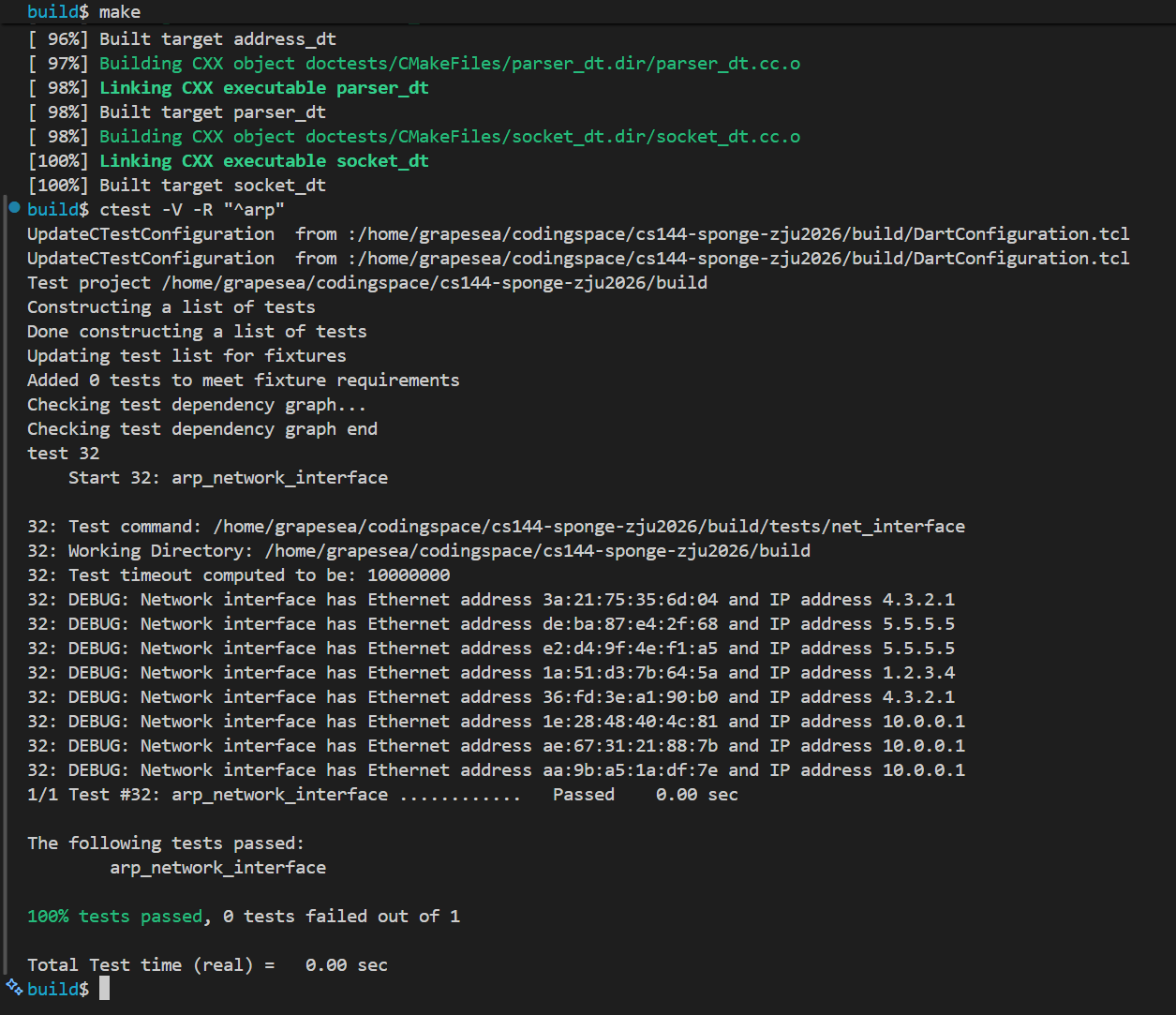
编译:
结果:
简易路由器
    //! Send a single datagram from the appropriate outbound interface to the next hop,
    //! as specified by the route with the longest prefix_length that matches the
    //! datagram's destination address.
    void route_one_datagram(InternetDatagram &dgram);
当一个 IP 数据报到达路由器时:
- 路由器检查数据报的目的 IP 地址。
- 与路由表中的所有条目进行匹配。
- 按照最长前缀匹配(Longest Prefix Match)原则选择最具体的路由。
- 根据匹配到的条目,将数据报从对应的接口转发到合适的下一跳。
对应下来就是:
//! \param[in] dgram The datagram to be routed
void Router::route_one_datagram(InternetDatagram &dgram) {
    if (dgram.header().ttl <= 1) { //如果数据报的 ttl 小于或等于 1,则直接丢弃
        return;
    }

    const uint32_t destination = dgram.header().dst;
    const RouteEntry *best_route = nullptr;

    for (const auto &route : _routes) {
        // /0 matches every address; handle it separately to avoid shifting by 32 bits.
        const u_int move_bits = 32 - route.prefix_length;
        const bool matches = route.prefix_length == 0 || (destination >> move_bits) == (route.route_prefix >> move_bits); // 对于一条路由,如果目的 IP 地址与 route_prefix 的高 prefix_length 位相同,则该路由匹配
        if (matches && (best_route == nullptr || route.prefix_length > best_route->prefix_length)) {
            best_route = &route; // 在所有匹配项中选择 prefix_length 最大的路由;
        }
    }

    if (best_route == nullptr) { // 如果没有匹配项,则丢弃数据报。
        return;
    }

    --dgram.header().ttl; // 否则将 ttl 减 1
    const Address next_hop = best_route->next_hop.value_or(Address::from_ipv4_numeric(destination)); // 大概这就是用std::optional的原因吧.
    // 如果所选路由的 next_hop 有值,则将其作为下一跳;如果 next_hop 为空,则将数据报的目的 IP 地址作为下一跳
    interface(best_route->interface_num).send_datagram(dgram, next_hop); // 最后,通过 interface_num 指定的接口发送数据报。
}
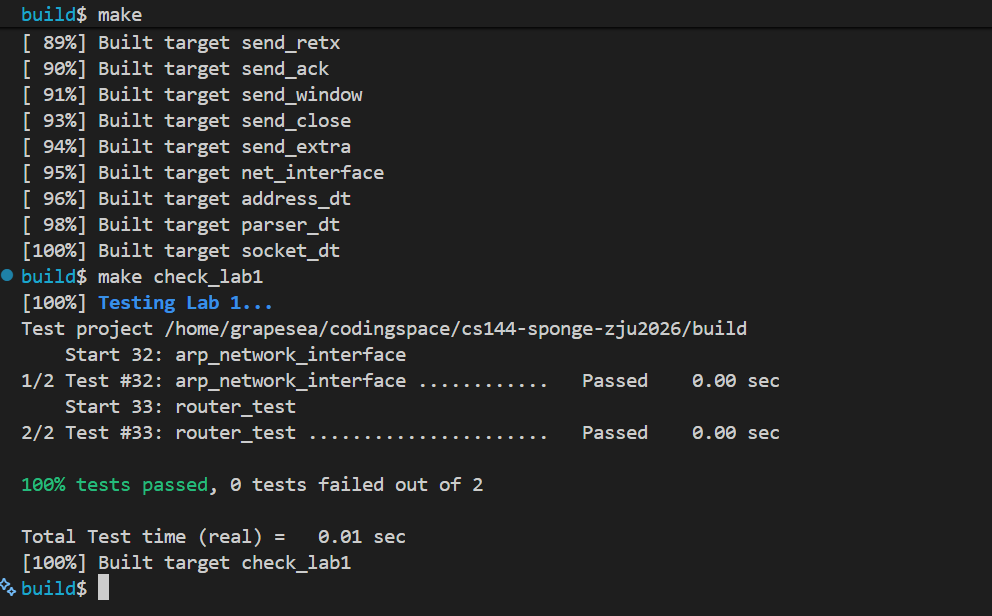
编译完成结算:
实验结果与分析 
结果分析
实验步骤已经给出了,符合预期.
思考题
-
通过代码,请描述network interface是如何发送一个以太网帧的?
入口是
send_datagram()(libsponge/network_interface.cc:23),输入为 IP 数据报和下一跳 IP 地址,发送过程如下:- 查询 ARP 缓存:使用下一跳 IP 查询
_arp_cache,获取对应的 MAC 地址。这里查询的是下一跳,可能是网关,也可能是同一局域网内的目标主机。 - 缓存命中时封装发送:创建
EthernetFrame,源 MAC 填本接口地址,目的 MAC 填查询结果,类型设为TYPE_IPv4,载荷填入dgram.serialize(),然后压入_frames_out. - 缓存未命中时发起 ARP 查询:先将数据报放入
_pending[next_hop_ip]等待队列,再构造 ARP 请求,以广播 MAC 地址为目的地址,封装成 ARP 以太网帧并压入_frames_out. 通过_arp_elapsed_time限制同一 IP 的 ARP 请求频率,5 秒内不重复发送。 - 学到 MAC 后发送等待的数据报:
recv_frame()(libsponge/network_interface.cc:82) 从收到的合法 ARP 报文中学习发送方的 IP—MAC 映射,然后遍历该 IP 对应的等待队列,再次调用send_datagram()完成封装。
本实验中,“发送”具体表现为将帧放入
_frames_out. 外部适配器负责取出帧、序列化并写入 TAP 设备,见send_pending()(libsponge/tcp_helpers/tuntap_adapter.cc:51) - 查询 ARP 缓存:使用下一跳 IP 查询
-
虽然在此次实验不需要考虑这种情况,但是当network interface发送一个ARP请求后如果没收到一个应答该怎么解决?请思考。
可以采用超时重试、有限次数、失败清理的机制:
- 为每个待解析 IP 记录等待时间和重试次数。超时仍未收到应答,就重新广播 ARP 请求,并限制重试频率。
- 达到最大重试次数或总等待期限后,判定本次地址解析失败,丢弃对应的等待数据报,并清理相关状态,避免无限等待。
- 限制等待队列长度,防止目标长期不可达时持续占用内存。
- 根据协议栈职责向上层报告发送失败;如果是路由器转发场景,可以在符合条件时生成 ICMP 目的不可达报文
-
请描述一下你为了记录路由表所建立的数据结构?为什么?
代码使用
std::vector<RouteEntry>保存路由表,每个表项是一个结构体,定义在router.hh(libsponge/router.hh:50):struct RouteEntry { uint32_t route_prefix{0}; // 目标网络前缀 uint8_t prefix_length{0}; // 前缀长度 std::optional<Address> next_hop{}; // 下一跳;为空表示直连网络 size_t interface_num{0}; // 出接口编号 }; std::vector<RouteEntry> _routes{};这样设计有以下原因:
- 结构体集中描述一条路由:网络前缀和前缀长度决定匹配范围,下一跳和接口编号决定如何转发。
- optional 清楚表达直连路由:有值时将报文交给指定下一跳;为空时,直接以数据报的目的 IP 作为下一跳,无须约定特殊地址。
- vector 简单且适合实验规模:添加路由时直接 push_back();查询时遍历所有表项,选择匹配且前缀最长的一项,不要求提前排序。
讨论、心得
中文和英文之间的理解切换似乎很不方便,有些字段用中文讲就看不懂什么意思了……于是回去看了CS144 Sponge 2021 Fall 的 lab5-lab6 文档.